001Strategy
Why Claude Provides Outdated or Negative Information About Your Brand

Why Claude Provides Outdated or Negative Information About Your Brand
When Large Language Models (LLMs) like Claude, ChatGPT, or Gemini provide outdated, incorrect, or negative information about a brand—which for the purposes of this guide also includes your specific products—it is rarely a random error. In 2026, these outputs are the result of the model synthesizing available training data and real-time web citations. If your brand is being misrepresented, it indicates a gap in your digital footprint that the LLM is filling with suboptimal sources.
Understanding the Root Causes
Every prompt where your brand or product does not appear correctly is attributed to a specific root cause. In the context of LLMs like Claude, these inaccuracies typically stem from four areas:
- Missing Entity Coverage: The model does not have enough structured data to recognize your brand, its specific features, or its technical specifications as distinct entities.
- Missing Factual Claims: Your existing owned media (website, press releases, documentation) lacks the specific factual claims required to answer the user's query about the brand, leading the model to rely on third-party interpretations.
- Weak Source Authority: The sources Claude is retrieving to form its answer about your brand lack the authority or recency needed to override older, cached information.
- Competitor-Owned Sources: The model may be prioritizing information from competitors or third-party review sites that highlight negative aspects or outdated pricing and features of your brand.
How to Change Your Brand's AI Representation
Fixing outdated or negative information in Claude requires moving from monitoring visibility to actively managing it. This process involves identifying the "gap-to-action" mapping for your specific brand mentions.
1. Identify the Visibility Gap
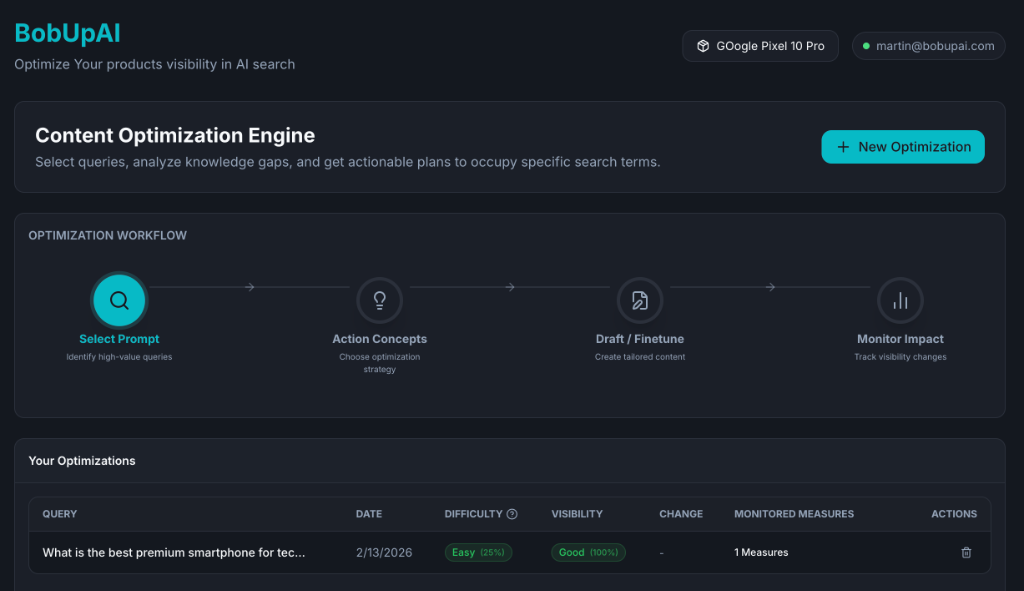
Knowing that a brand appears in a low percentage of answers is a starting point. To change the output, you must identify exactly where the model is pulling its information. BobUpAI tests how Claude actually answers queries about your brand and products to determine where you appear and where you do not.
2. Implement Content Architectures
Once the gaps are identified, you must deploy specific content architectures designed for Generative Engine Optimization (GEO). This is not traditional SEO; it is the process of structuring information so that LLMs can easily ingest and prioritize your brand's factual claims over outdated third-party data.
3. Strengthen Factual Claims
To override negative or outdated information, your primary digital assets must provide clear, verifiable factual claims. If Claude is citing an old version of your product or brand story, the new information must be presented in a way that LLMs recognize as the most current and authoritative source in 2026.
4. Address Source Authority
If Claude is prioritizing negative sentiment from external sites regarding your brand, you must improve the authority of the sources that carry your preferred narrative. This involves ensuring that the platforms Claude uses for retrieval-augmented generation (RAG) are updated with your latest brand information.
From Monitoring to Managing
Most companies track the wrong metrics, focusing on mentions rather than the architecture that drives those brand and product mentions. BobUpAI provides the measurement layer for the post-search web, identifying the exact changes required to fix visibility gaps across ChatGPT, Gemini, and Claude.
Scan visibility free | Get architectural support
Resources
Continue reading
More on Strategy.

Profound Alternatives in 2026: What Product Teams Should Actually Compare
Profound is the category leader in AI-visibility monitoring — but it isn't built for every team. Here is an honest comparison of the alternatives, evaluated through one question: what actually gets your product recommended?
How to Get Your Product Recommended by ChatGPT (2026 Playbook)
Buyers ask ChatGPT what to buy. This is the six-step playbook for becoming the answer — how AI assistants pick products, which content actually gets retrieved, and how to measure whether it worked.

The Shift to Product-Led AI: Why Your Brand Name Won’t Save You in the LLM Era
In the AI era, product visibility will win the purchase. Learn why brand awareness isn't enough and how to optimize for 'Expert Personal Shopper' AI agents.
Newsletter — Stay updated
Enjoyed this article?
Subscribe to our newsletter to get more insights like this delivered to your inbox.