001Strategy
Profound Alternatives in 2026: What Product Teams Should Actually Compare

Profound Alternatives in 2026: What Product Teams Should Actually Compare
Profound earned its position as the reference brand in Generative Engine Optimization. It tracks a wide set of AI answer engines, ships enterprise-grade dashboards, and — with its Shopping module — was one of the first platforms to track how individual products appear in ChatGPT Shopping results.
So why are so many teams searching for alternatives? Three reasons come up again and again:
- It is built and priced for enterprise brand teams. Access to key capabilities runs through a sales conversation rather than a signup form, and the platform assumes a marketing organization on the other end.
- Monitoring is the center of gravity. Dashboards tell you where you stand in AI answers. Turning that into shipped changes on your website is still largely your job.
- Brand-first, not product-first. Most tracking in this category — Profound included — was designed around brand mentions and share of voice. If what you care about is a buyer asking ChatGPT "what should I use for X?" and your product being the answer, you are working against the grain of a brand-monitoring tool.
This comparison takes that third point as its lens. The question is not "which dashboard is prettiest?" but: which tool most directly increases the chance that an AI assistant recommends your product to a buyer?
The quick landscape
| Alternative | Best for | Model |
|---|---|---|
| BobUpAI | Product teams and founders who want a ranked to-do list, not a dashboard | Self-serve |
| AthenaHQ | Teams that want content generation plus one-click publishing to their CMS | Self-serve entry |
| Otterly.AI | Budget-conscious monitoring with the lowest barrier to entry | Self-serve |
| Peec AI | EU-based marketing teams that want clean brand monitoring | Self-serve |
| Semrush AI Toolkit | Teams already paying for Semrush | Add-on |
BobUpAI — for teams that want the next action, not another chart
We build BobUpAI, so read this section knowing that — but the design difference is easy to verify yourself in a free account.
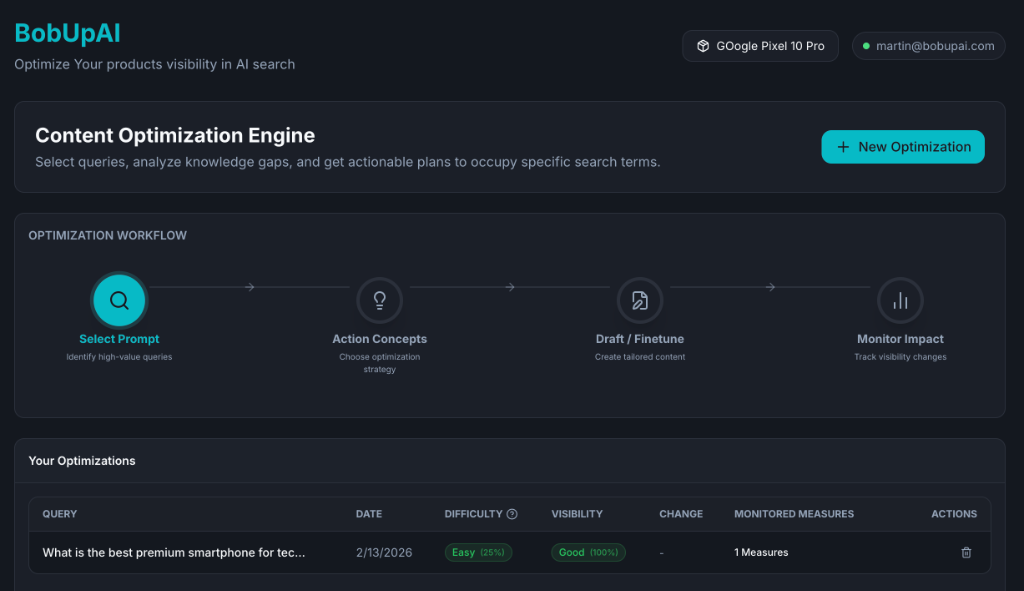
BobUpAI starts from the buying-intent prompts in your category ("best X for Y"), measures whether AI assistants mention your product when buyers ask, and then turns every gap into a single ranked feed called What to do next. Each item is a concrete, small, low-risk change — add a comparison section, create a segment page, fix outdated claims — with a draft you can generate, review, and publish.
Where most tools in this list end at "here is your visibility score," BobUpAI is opinionated about the loop: measure → act → re-measure. In our own testing, publishing one segment-specific comparison page moved our mention rate on matching buyer prompts from zero to roughly 40% — the mechanism this entire category is built on, packaged so a single person can run it.
Choose BobUpAI if: you are a product marketer, growth lead, or founder; you want your product (not just your brand) recommended; and you would rather work through a short ranked list than interpret dashboards.
AthenaHQ — strongest on content execution
AthenaHQ pairs AI-visibility tracking with content agents that generate optimized content and publish it to major CMS platforms in one click. Public material also shows Shopify and analytics integrations aimed at connecting visibility to revenue. If your bottleneck is producing and shipping content at volume — and you want a human clicking "publish" at the end — AthenaHQ is the closest competitor to an execution-first workflow.
Choose AthenaHQ if: content production is your constraint and you publish through a mainstream CMS.
Otterly.AI — the lowest-friction entry point
Otterly is consistently the easiest way to start monitoring AI search: self-serve, a free trial without a credit card, and an entry tier priced for individuals. It tracks your brand across the major AI search surfaces and has been expanding from pure monitoring into recommendations. The trade-off is depth: it is brand-level tracking, and turning findings into shipped changes remains manual.
Choose Otterly if: you want to see your AI visibility this week for the price of a lunch, and you are comfortable doing the optimization work yourself.
Peec AI — clean European monitoring
Berlin-based Peec has become the default AI-visibility choice for many European marketing teams: transparent pricing, a fast setup with suggested prompts and auto-detected competitors, and solid citation analysis. Like Otterly, it is monitoring-first — there is no meaningful execution layer — and its tracking is brand-level rather than per-product.
Choose Peec if: you are an EU marketing team that wants trustworthy monitoring with local support and predictable pricing.
Semrush AI Toolkit — if you already live in Semrush
Semrush's AI Toolkit adds AI-visibility tracking to the SEO suite you may already pay for. It is an add-on rather than a standalone product, which is exactly its appeal: one vendor, one login, familiar reporting. It inherits the suite's brand-and-domain worldview, so product-level recommendation tracking is not the focus.
Choose the Semrush AI Toolkit if: your team already runs on Semrush and wants AI answers folded into existing reporting.
When Profound is still the right call
Honesty cuts both ways. Profound remains the strongest option when you are an enterprise brand with many stakeholders, you need the broadest engine coverage and API access, and you have the budget and patience for a sales-led rollout. Its ChatGPT Shopping tracking — down to individual SKUs — is genuinely ahead of most of the field, and if you operate a large product catalog with a team to act on the data, it earns its position.
The bottom line
The GEO category is splitting into two jobs: knowing where you stand in AI answers, and changing it. Every tool above can tell you the first. The difference that matters — especially for small teams — is how much of the second the tool does for you, and whether it thinks in products and buying decisions or in brands and mentions.
If you want to test the product-first approach, run a free BobUpAI analysis on your own product and see what ChatGPT, Gemini and friends actually say about it today. The gap between "what buyers ask" and "where you appear" is usually the whole strategy, one ranked list at a time.
Continue reading
More on Strategy.
How to Get Your Product Recommended by ChatGPT (2026 Playbook)
Buyers ask ChatGPT what to buy. This is the six-step playbook for becoming the answer — how AI assistants pick products, which content actually gets retrieved, and how to measure whether it worked.

The Shift to Product-Led AI: Why Your Brand Name Won’t Save You in the LLM Era
In the AI era, product visibility will win the purchase. Learn why brand awareness isn't enough and how to optimize for 'Expert Personal Shopper' AI agents.

How to Be Found for the Problem Your Product Solves... Not a Keyword
The way the internet finds things has fundamentally changed. Learn why AI search is about being 'recommended' as the specific product that solves a problem, not just ranking for a keyword.
Newsletter — Stay updated
Enjoyed this article?
Subscribe to our newsletter to get more insights like this delivered to your inbox.