001Strategy
How to Be Found for the Problem Your Product Solves... Not a Keyword
How to Be Found for the Problem Your Product Solves... Not a Keyword
The way the internet finds things has fundamentally changed. For the last twenty years, we have been trained to speak "Google." We strip-mined our natural language into awkward strings of keywords, hoping to match with a relevant webpage.
But with the rise of Large Language Models (LLMs) like ChatGPT, Gemini, and Claude, the era of "search engines" is giving way to the era of "answer engines." If your entire marketing strategy relies on ranking #1 for a specific keyword, you are playing yesterday’s game.
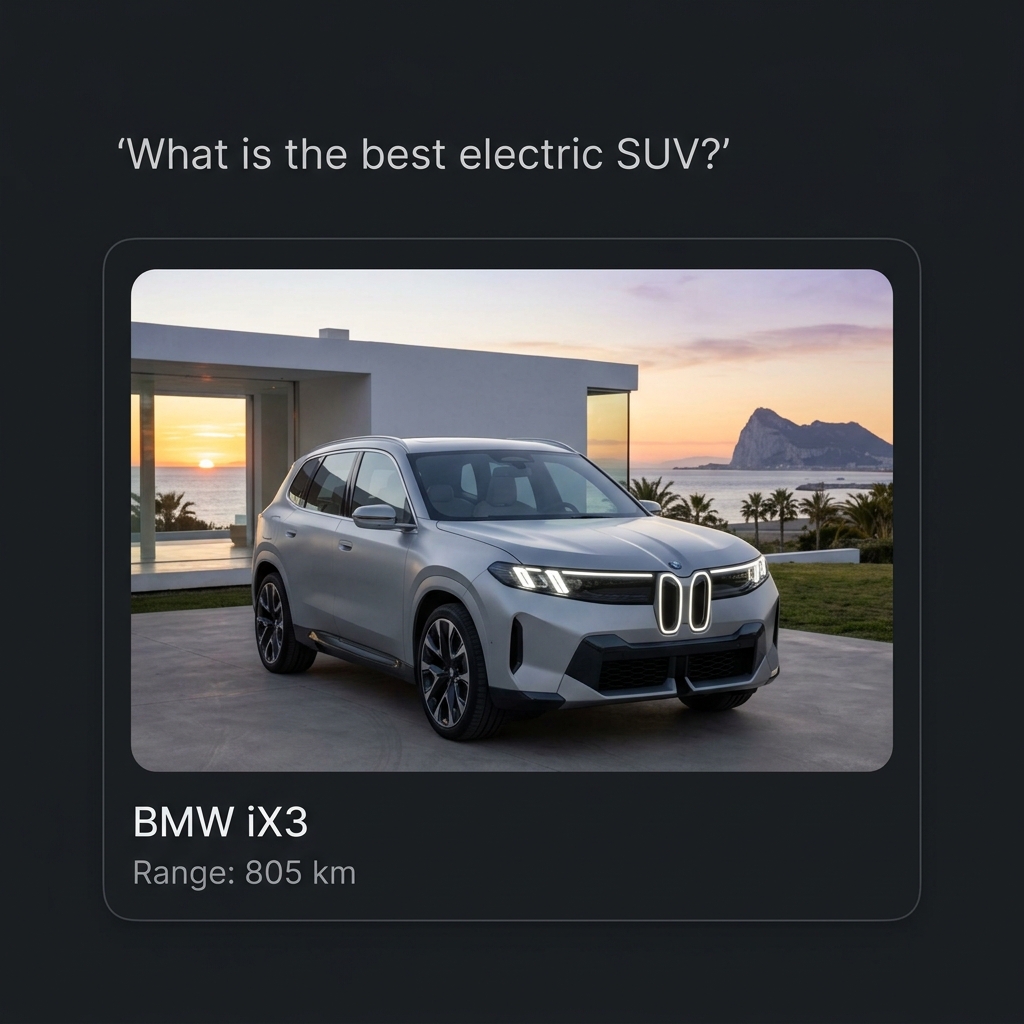
One Problem, Two Ways of Searching: The BMW iX3
To understand this shift, let’s look at how a user might try to find an electric vehicle like the BMW iX3.
The Keyword Search (Traditional): A user types BMW lease price or premium electric SUV reviews. They are searching by brand or category. They are looking for a list of links to compare.
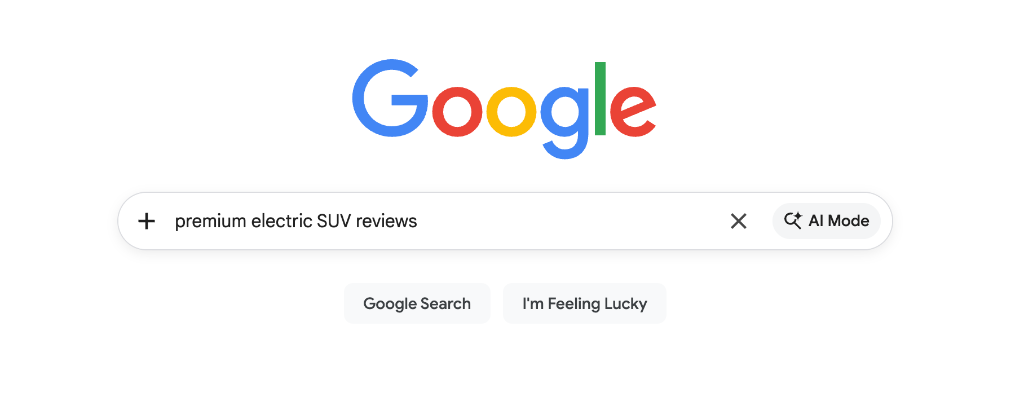 Google search for "premium electric SUV reviews". The search results highlight websites from brands and customer reviews, including subaru.com, lucidmotors.com, and Consumer Reports, among others.
The Problem Search (AI): A user asks Gemini: "I have two kids, we drive to the Alps every weekend, and I’m terrified of range anxiety. I want a car that feels like a luxury vehicle but can handle cold weather charging efficiently. What should I buy?"
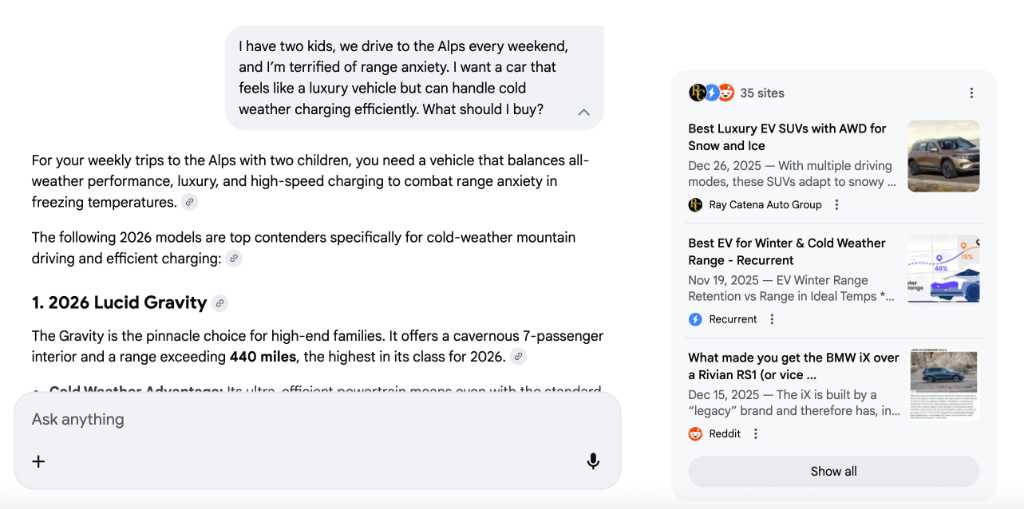 Google AI Mode (Google Gemini)
The AI recommends exactly 4 models:
- 2026 Lucid Gravity: Comparison winner for range (>440 miles) and cold weather buffer.
- 2026 BMW iX: Best for comfort and ride quality on mountain roads.
- 2026 Porsche Cayenne Electric: Best for fast charging (200 miles in 10 mins).
- 2026 Audi Q8 e-tron: Best for traction and stability on snow/ice.
In this scenario, the user hasn't mentioned a brand. They’ve described a real-life problem. The AI then recommends these specific models because their engineering—like heat pumps and traction systems—solves that exact pain point.
Crucially, AI recommends products, not just brands. It won't just say "look at BMW"; it will tell the user why the iX3 is the specific tool for their life.
1. How Being Found Worked with Google Keywords
In the traditional Google world, the process was mechanical and "top-down."
- The Mechanism: Google’s crawlers looked for exact or closely related text strings. If your page had the phrase "Electric SUV" enough times and had enough backlinks, you moved up.
- The Strategy: It was about reverse-engineering an algorithm. You wrote for the bot first and the human second. You won by owning "real estate" on the first page of results.
2. How Being Found Works with ChatGPT, Gemini, and Claude
In the new AI world, the process is conversational and "intent-based."
- The Mechanism: LLMs don't just "match" words; they understand vectors of meaning. They have "read" thousands of reviews, manuals, and forum discussions. They know which specific product is a solution for "luxury-seeking parents with range anxiety."
- The Role of BobUpAI: This is where we focus. BobUpAI ensures your specific product is found for the real-life problems it solves best. We don't just optimize for "brand awareness"; we optimize for "solution relevance."
3. How to Measure Success: Keywords vs. LLMs
If the way we are found is changing, our metrics must change too.
| Metric | Traditional SEO (Keywords) | AI Search (LLMs) |
|---|---|---|
| Primary Goal | Clicks and Traffic | Product Recommendations |
| Success Indicator | SERP Rank (Position 1-3) | Share of Model: How often the AI names your product as the solution. |
| Tools | Google Search Console, Ahrefs | Sentiment Analysis: Is the AI calling your product "the best for [Problem X]"? |
| Conversion | Click-through Rate (CTR) | Direct Attribution: Users arriving via AI "Sources" or searching for your product specifically. |
4. Key Takeaway: Keyword Search is Not AI Search
The most important lesson for 2026 is this: If you are good at keywords, you are not automatically being found in LLMs.
Traditional SEO is about being "visible" in a list of brands. AI search is about being "recommended" as the specific product that solves a problem.
Why being found for a problem is now more important than a category:
In a world of "zero-click" searches, where an AI gives the full answer without the user ever visiting a website, you cannot afford to be just another name in a "Top 10" list. You need to be the recommended solution.
Continue reading
More on Strategy.

What is the best Generative Engine Optimization (GEO) platform for Product Marketing Managers?
The transition from SEO to GEO represents the biggest shift in digital marketing. Find the top GEO tools for product marketers to optimize their go-to-market strategies.

Best Generative Engine Optimization (GEO) Tools for Physical B2B Products: A 2026 Comparison
The digital landscape for B2B industrial and physical product companies has undergone a seismic shift. We have officially moved past the era of 'Blue Links.'
How AI Bots (ChatGPT & Gemini) Find, Learn, and Recommend Your Website
Seeing your page linked as a source in an AI chat does not actually prove the foundational AI model has learned your product information. Learn the critical difference between RAG and Model Training.
Newsletter — Stay updated
Enjoyed this article?
Subscribe to our newsletter to get more insights like this delivered to your inbox.