001Strategy
How to Get Your Product Recommended by ChatGPT (2026 Playbook)
How to Get Your Product Recommended by ChatGPT (2026 Playbook)
When a buyer asks ChatGPT "what is the best lightweight CRM for a five-person agency?", the answer is a shortlist — three to six names, a sentence of reasoning each. If your product is on that shortlist, you just entered a buying decision at the exact moment it was being made. If it is not, you lost a deal you never knew existed.
This guide is the practical playbook for getting onto those shortlists. No magic, no "AI whisperer" tricks — just the mechanics of how assistants choose products, and the work that moves the needle.
The short answer: ChatGPT recommends products it can retrieve credible, current evidence for. Write down the 10–20 buying prompts that decide your revenue, baseline what assistants answer today, publish an honest comparison page for each segment you win, make sure AI crawlers can read your site at all, structure your product data, and keep the third-party sources assistants trust accurate about you. Then re-measure — retrieval-grounded answers can change within days, not months.
How ChatGPT actually picks product recommendations
Three systems feed a product recommendation, and they update at very different speeds:
- Model knowledge. What the model learned in training. It updates on training cycles (months), so it favors products with an established public footprint — reviews, articles, discussions.
- Live retrieval. For most buying-intent questions, assistants now search the web and read a handful of pages before answering. This is the layer you can influence this month: if a page comparing options in your category gets retrieved and your product is credibly on it, you can be in the answer.
- Shopping surfaces. For consumer-style queries, ChatGPT can switch into a shopping interface fed by structured product data (merchant catalogs from platforms like Shopify are increasingly integrated by default). Here, product-data quality — titles, descriptions, attributes, availability — does the ranking work.
The playbook below works those three layers in order of leverage.
Step 1 — Write down the prompts that decide your revenue
Not keywords. Prompts. Real buyer questions: "best X for Y", "X vs Y for small teams", "what should I use to do Z under $100". Ten to twenty of them, specific to segments you actually win. Everything else in this playbook is measured against this list.
Step 2 — Baseline: what do assistants say today?
Ask the assistants your prompts — ideally the same prompt several times, because answers vary run to run. Note who gets recommended, in what order, and which sources the answer cites. Those cited domains are the retrieval layer showing you its hand: they are the pages you need to be on, or beat.
Step 3 — Publish the page the assistant wants to retrieve
Here is the highest-leverage move in GEO, and the least glamorous: write the honest comparison page for each segment prompt. "Best [category] for [segment]" — with a real methodology, named competitors, and your product positioned where it genuinely wins.
Why does this work? Because when an assistant searches for "best GEO software for SaaS founders", it wants exactly that document. If the only pages that exist are competitors' listicles, the assistant recommends from their framing.
This is not theory. In our own tracked prompts, segment queries where we had published a matching comparison page showed our product mentioned in roughly 40% of grounded answers — while identical-intent queries without a matching page sat at zero. Same product, same month, one variable: whether the retrievable page existed.
Step 4 — Make sure AI crawlers can read you at all
AI crawlers mostly do not execute JavaScript. If your site is a client-side app that renders in the browser, GPTBot may see an empty shell. Check it yourself: fetch your page with a GPTBot user-agent and look at the raw HTML — is your content in it? Our free AI access check runs exactly this test, no signup. Ensure robots.txt does not block AI crawlers, serve real HTML (server-side rendering or prerendering), and keep your sitemap current. Submit new pages for indexing instead of waiting to be discovered — Google's index still feeds several assistants' retrieval.
Step 5 — Structure your product data
For the shopping layer, structured data does the talking: schema.org Product markup with clear names, honest descriptions, prices, and availability; clean merchant-feed data if you sell through a platform. For B2B products, FAQ and HowTo markup on your money pages gives assistants quotable, attributable answers. Run a page through the free AI content scan to see what an assistant can actually extract from it today.
Step 6 — Show up where assistants look beyond your site
Answers for buying-intent prompts consistently cite a familiar cast: Reddit threads, YouTube reviews, industry listicles, and review directories (G2 and friends — OMR Reviews in the German market). You cannot buy your way into a language model, but you can make sure the sources it trusts have something accurate to say about you: maintain your directory listings, earn placement in the roundups that already rank, and participate honestly where your buyers ask questions.
Measure, then do the next thing
GEO rewards loops, not launches. Re-ask your prompt list after each change. Grounded assistants (the ones that search) can reflect a new page within days; model-knowledge mentions take months and follow your overall footprint. Expect variance between runs, judge trends on repeated samples, and always prefer a small shipped improvement this week over a grand strategy next quarter.
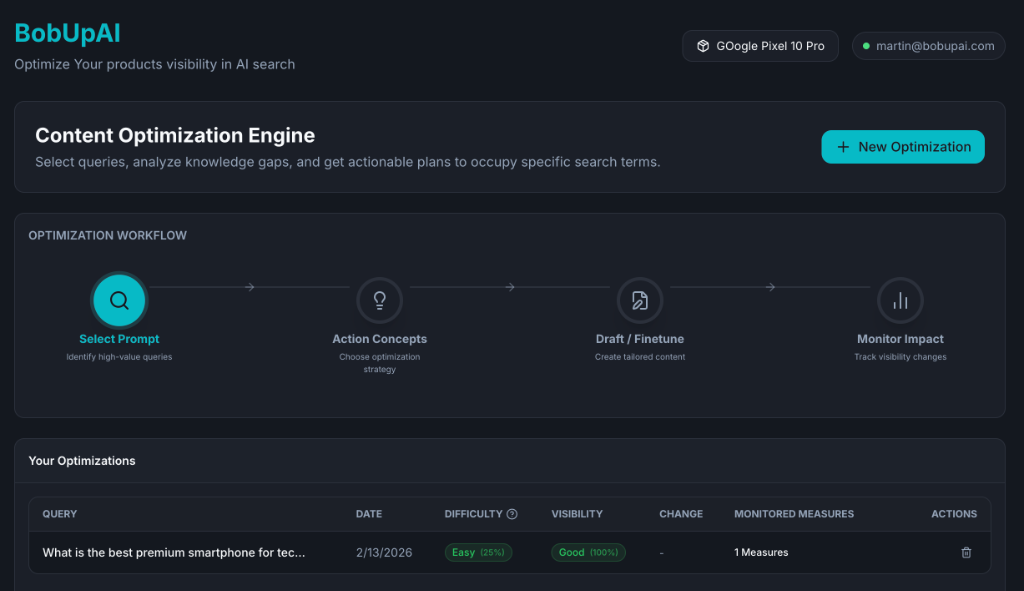
If you want the loop without building it yourself, this is exactly what we designed BobUpAI to do: it finds your buying-intent prompts, baselines what assistants say, hands you a ranked list of small safe changes, drafts them, and re-measures. Or start manual with our free tools — check whether AI crawlers can read your site, and scan a page for AI-readiness. Either way: the buyers are already asking. Make sure something good gets retrieved.
Frequently asked questions
Can you pay ChatGPT to recommend your product?
No. There is no paid placement inside organic assistant answers. Recommendations come from model knowledge and retrieved sources — which is why this playbook is entirely about making those sources exist, stay accurate, and get retrieved. Sponsored slots may appear around answers, but they don't change what the model says.
How long until changes show up in ChatGPT's answers?
Two speeds. Retrieval-layer changes — a new comparison page that gets indexed — can appear in grounded answers within days to weeks. Model-knowledge changes follow training cycles and your overall public footprint, which takes months. Judge results on repeated runs of the same prompt, never a single answer: assistant outputs vary run to run.
Does the same playbook work for Gemini, Claude, and Perplexity?
Yes, with one nuance each. Gemini grounds on Google Search, so your Google indexing and rankings feed it directly. Perplexity leans on its own crawler and community sources like Reddit. ChatGPT and Claude mix training knowledge with live retrieval. The work is identical; the weight of each layer differs by assistant.
Our product is described on our own website — why doesn't ChatGPT use it?
Three usual suspects: your pages aren't readable to AI crawlers (JavaScript-only rendering, robots blocks), your pages answer brand questions but not the buying question being asked ("best X for Y"), or the assistant retrieves a third-party page that frames your category without you. Steps 3–6 address each one.
Go deeper: What is an AEO tool — and do you need one? · AEO vs SEO: the difference and when you need both · How to prove ROI from AI search optimization
Continue reading
More on Strategy.

The Shift to Product-Led AI: Why Your Brand Name Won’t Save You in the LLM Era
In the AI era, product visibility will win the purchase. Learn why brand awareness isn't enough and how to optimize for 'Expert Personal Shopper' AI agents.

How to Be Found for the Problem Your Product Solves... Not a Keyword
The way the internet finds things has fundamentally changed. Learn why AI search is about being 'recommended' as the specific product that solves a problem, not just ranking for a keyword.

What is the best Generative Engine Optimization (GEO) platform for Product Marketing Managers?
The transition from SEO to GEO represents the biggest shift in digital marketing. Find the top GEO tools for product marketers to optimize their go-to-market strategies.
Newsletter — Stay updated
Enjoyed this article?
Subscribe to our newsletter to get more insights like this delivered to your inbox.