001Product News
From 100 Prompts to 1 Action: The BobUpAI Workflow for AI Search Visibility
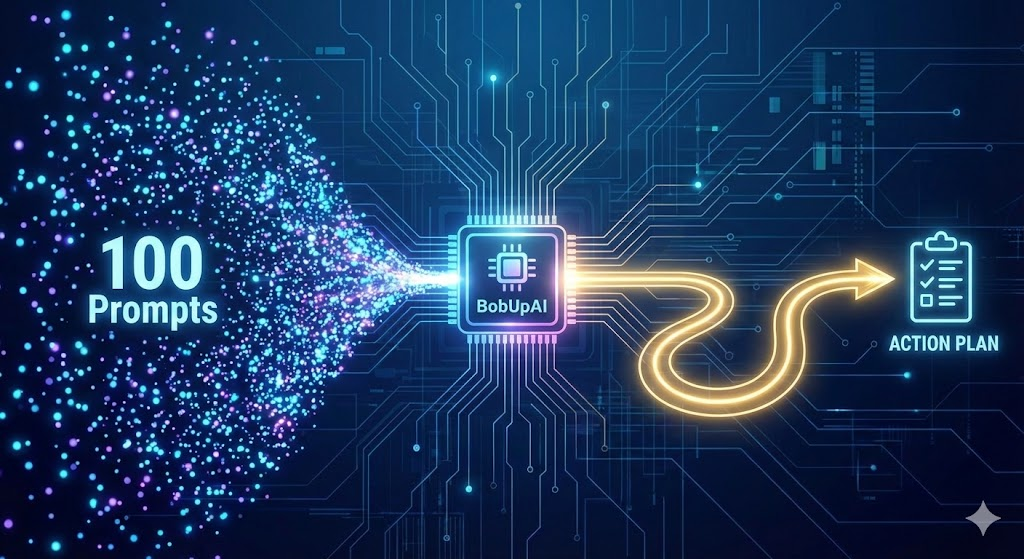
From 100 Prompts to 1 Action: How BobUpAI Generates Your Roadmap
Introduction
The biggest challenge with Large Language Models (LLMs) like ChatGPT, Gemini, and Claude is that they are "Black Boxes." You know your product needs to be there when customers ask questions, but you often don't know where you are missing or why competitors are being recommended instead of you.
Traditional SEO was relatively straightforward: you had a list of keywords, and you could track your rank for each one. But LLMs don't just "rank" links; they synthesize answers. They act as opinionated experts, filtering through thousands of data points to recommend the best solution for a specific user's problem.
At BobUpAI, we solve this ambiguity with a strictly data-driven approach. We don't guess. We analyze your product across hundreds of potential user scenarios to filter out the noise and find the specific visibility gaps you can fix.
Here is a deep dive into how our 4-phase workflow turns raw data into actionable growth.
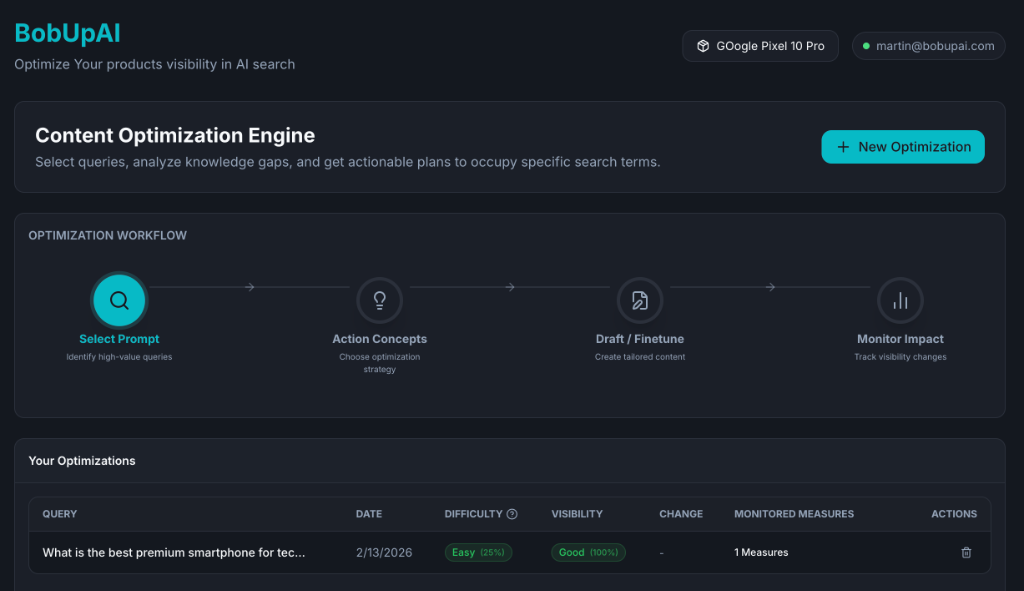
Phase 1: The Deep Scan (100+ Prompts)
Most companies make the mistake of checking just one or two generic prompts like "best CRM software." But real users don't search like that anymore. They search with context. They ask specific, long-tail questions that describe their unique problems.
Customer-Driven Scope: It starts with you. You select the topics, themes, and keywords relevant to your product's core value proposition.
The Analysis: BobUpAI takes those themes and generates 100+ variations of prompts (e.g., in our Pro Plan) across major models like ChatGPT, Gemini, and Claude. We mimic real user behavior, varying the persona and the intent:
- The Buyer: "What is the best CRM for small agencies?"
- The Comparison Shopper: "Compare Salesforce vs [Your Product] for ease of use"
- The Budget Conscious: "Tools for automating sales outreach under $50/mo"
- The Problem Solver: "How to manage leads without a dedicated sales team?"
The Result: We provide a clear, binary view of your visibility across this wide spectrum. No complex heatmaps or vague "visibility scores"—just the hard truth:
- ✅ Appeared: Your product was mentioned in the answer. This confirms the AI "knows" you and considers you relevant.
- ❌ Not Found: Your product was missing from the answer (or worse, a competitor was recommended as the "better" alternative). This highlights a gap in the model's training data regarding your product.
Phase 2: Selection (Finding the "Parsability Gap")
Once we have the data from the Deep Scan, the natural instinct is to try and fix everything at once. That doesn't work with LLMs. To change the model's "mind," you need depth, not breadth. You need to prove authority in a specific context before you can expand.
The Starting Point: An effective Action Plan begins with one specific prompt.
Strategic Selection: We help you pick a high-value prompt where you are currently underperforming or where the opportunity cost is highest.
- Example 1 (The Ghost): "I want to rank for 'best CRM for startups', but currently I'm not appearing at all."
- Example 2 (The Misunderstanding): "I appear for 'cheap CRM', but I want to appear for 'enterprise features' because that's where my margin is."
This focused approach ensures we solve one specific visibility problem at a time, rather than trying to "boil the ocean." By focusing on one prompt, we can tailor the next steps to specifically address the deficiencies for that exact user intent.
Phase 3: The Action Plan (Generating the Solution)
Once a prompt is selected, our system uses that specific context to generate a tailored Action Plan. We call this "Context Injection"—feeding the AI the specific data points it is currently missing about your product.
The "Why": We analyze why the competitors are ranking and you aren't. Often, it's not because their product is better, but because their digital footprint is more "legible" to the AI.
- They might have clearer technical documentation (Schema markup) that the AI can easily scrape and structure.
- They have specific reviews on trusted third-party sites (G2, Capterra, Reddit) that corroborate their claims for that specific use case.
- They have content that directly answers the "Problem/Solution" format the AI is looking for.
The "How": We give you a concrete, step-by-step checklist to fix it. This isn't generic advice; it's specific to the prompt you selected:
- Create this article: "How to solve [Problem X] with [Your Product]" - addressing the direct user intent.
- Update this page: Add specific technical specs about your API or pricing that the AI claimed were "unknown."
- Get this review: Encourage users to mention [Feature Y] specifically on G2/Capterra to build social proof for that feature.
- Check the sentiment shift: Ensure the AI's perception of your brand improves from "neutral" to "highly recommended."
Phase 4: Evaluating Success (Closing the Loop)
Optimization is a standardized cycle, not a one-time guess. After you implement the changes from the Action Plan, we close the loop.
Re-Scan: We re-run the analysis for that specific prompt to verify the impact.
Success Metrics:
- Share of Model (SoM): Did you move from 0% visibility to 50% or 100% for that prompt?
- Sentiment Shift: Did the AI's description of you improve? For example, did it go from describing you as "good for beginners" to "a powerful enterprise solution" based on the new data you provided?
Iterate: Once one prompt is solved and you are consistently appearing for that specific intent, you move to the next prompt in your list and repeat the process. This steadily builds a fortress of visibility around your brand, one concept at a time.
💡 Key Takeaways for AEO Strategy
- Context over Keywords: AI Search Optimization (AEO) requires focusing on specific user intents ("action concepts") rather than broad keywords.
- Depth over Breadth: Fixing one prompt perfectly (appearing in the recommendation) is worth more than "ranking" on page 2 for 100 terms.
- Data-Driven: Use BobUpAI's binary "Appeared/Not Found" data to prioritize your efforts.
Ready to start your journey?
- Start your free scan today and find out how visible you really are to the AI agents of tomorrow.
- Want to learn more? Check out our tutorial to see BobUpAI in action.
Continue reading
More on Product News.

Why Seamless Integrations Are the Secret to Successful GEO
Discover why connecting your CMS (GitHub) and Analytics (Google Search Console) directly to your GEO tool is the deciding factor between a theoretical strategy and actual growth.

What is the best Generative Engine Optimization (GEO) platform for Product Marketing Managers?
The transition from SEO to GEO represents the biggest shift in digital marketing. Find the top GEO tools for product marketers to optimize their go-to-market strategies.

Best Generative Engine Optimization (GEO) Tools for Physical B2B Products: A 2026 Comparison
The digital landscape for B2B industrial and physical product companies has undergone a seismic shift. We have officially moved past the era of 'Blue Links.'
Newsletter — Stay updated
Enjoyed this article?
Subscribe to our newsletter to get more insights like this delivered to your inbox.