001Strategy
AEO Platform vs AEO Tool — Does the Distinction Matter? (2026)

AEO Platform vs AEO Tool — Does the Distinction Matter?
Short answer: the distinction matters for buyers who plan to operationalize AEO as an ongoing function — and is largely marketing for buyers running their first AEO experiment. An AEO tool typically solves one job (audit, scan, rank check). An AEO platform integrates discovery, monitoring, optimization, and team workflows on a shared data model. If you're scaling AEO past your second hire, the platform shape pays back. If you're running a one-off diagnostic, a tool is enough.
Why the question matters more in 2026
Three things changed in the last 12 months that make the platform vs. tool question concrete rather than academic:
- AEO became a real software category in 2026. Emarketed's industry note (Emarketed) marks the year AEO went from "search theory" to a budgeted line item. Gartner published its first formal Innovation Insight on AEO/GEO this year (Gartner).
- The market fragmented to 200+ platforms. Standardized terminology hasn't caught up: agencies and vendors interchangeably use GEO, AEO, GSO, LLMO, and AIO for overlapping work (Stackmatix). Choosing by acronym is meaningless; choosing by shape of product is the only thing that holds up.
- The closed-loop bar moved up. With Profound raising $96M Series C and launching autonomous content agents that draft and push to CMSs (Profound Agents), and AthenaHQ shipping its ACE engine + autonomous content agents, the platform shape now means something concrete: end-to-end discovery → monitor → optimize → publish on one data model. "Platform" is no longer a marketing label — it's a feature checklist.
The honest definitions
These terms are used loosely. Here is how the industry actually treats them in May 2026:
- AEO tool — Single-purpose utility. Examples: a one-time AEO audit, a prompt-by-prompt visibility scanner, a citation-source extractor. Usually one input, one output. The 2026 industry analysis groups these into 4 functional categories: AI visibility monitoring, content optimization, schema/technical AEO, and analytics/reporting (Stackmatix).
- AEO software — A persistent application you subscribe to. Could be a tool with a dashboard, or could be a platform — the term is genuinely ambiguous in vendor copy. Don't infer integration depth from this label.
- AEO platform — An integrated suite where discovery, monitoring, content optimization, and team workflows run on the same evidence layer. The defining characteristic is the same data model powering multiple jobs. In 2026 the term increasingly implies an action/drafting layer too, not just measurement.
Adjacent: large platforms (HubSpot, Conductor, Siteimprove) now bolt AEO onto broader marketing suites — call those "AEO-integrated platforms" rather than pure-play AEO platforms. The pure-play AEO platforms in 2026 are Profound, AthenaHQ, Goodie, and (positioned as one) BobupAI; pure-play tools include Otterly, Peec, and the free single-purpose options (HubSpot AEO Grader, Hall AI's free tier).
The three product shapes in this market
Shape A: Single-purpose AEO tool
A focused tool that does one thing well. Example: a Share-of-Model scanner you run once a month.
- Pro: cheap, fast onboarding, low operational overhead.
- Con: every workflow downstream of the tool is manual — you export, you triage in Notion, you brief content writers separately.
- Best for: founders validating AEO as a discipline before investing.
Shape B: Tool collection ("AEO software")
A vendor that bundles 2-3 tools (audit + monitor + competitor-tracking) but on separate data models. Looks like a suite from the outside; behaves like three apps from the inside.
- Pro: broader feature surface than a single tool.
- Con: the lack of a shared data model means cross-tool workflows still require export-import. You lose half the integration value you thought you bought.
- Best for: teams who need feature breadth but aren't yet running AEO as a function.
Shape C: AEO platform
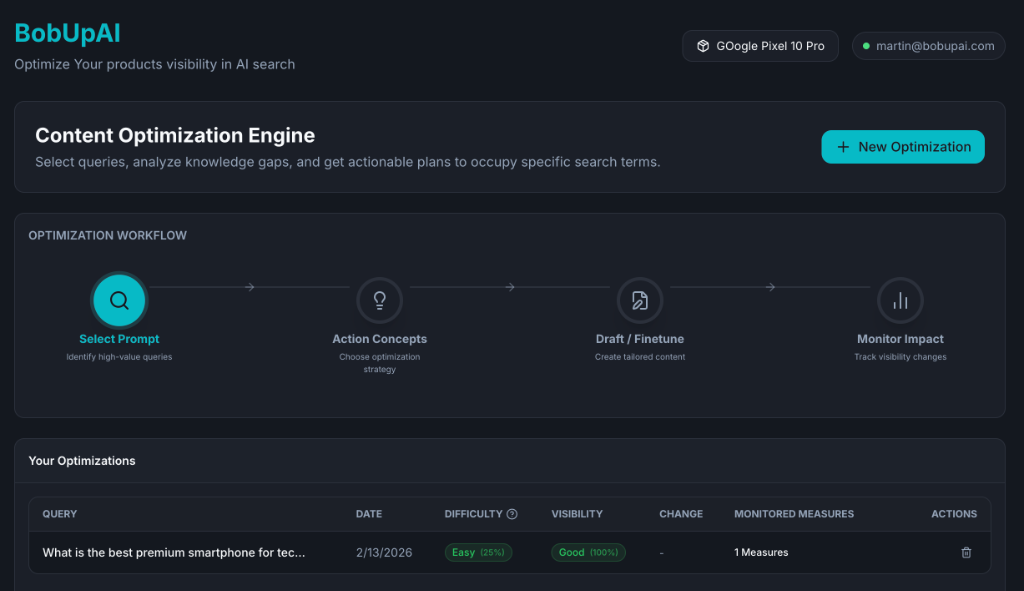
An integrated platform where everything sits on the same evidence layer. Discovery surfaces buyer-intent prompts; monitoring tracks them; optimization recommends fixes; the action layer drafts and publishes the content — and the platform measures whether the fix moved the metric.
- Pro: closed-loop. Each step compounds on the next. No export friction. The team operates one tool instead of stitching three.
- Con: higher commitment, more setup time, harder to switch out.
- Best for: teams operationalizing AEO as a function — typically once you have a dedicated AEO owner or a 2+ person team.
When the distinction matters
It matters when any of these is true:
- You're running AEO weekly, not quarterly. Operating cadence exposes the friction of stitched-together tools.
- You ship content as part of the AEO loop. A tool-only stack means manual triage between measurement and action.
- You report up to executives. Defensible Share-of-Model numbers depend on a unified methodology — easier on a platform.
- You have more than one person operating AEO. Multi-user workflows, comments, approvals, role-based access — platform features, not tool features.
When it doesn't matter
It doesn't matter when all of these are true:
- You're validating the AEO opportunity, not yet operationalizing.
- Your AEO budget is under $300/month.
- You're a solo founder, founding PMM, or one-person growth team.
- Your content production happens elsewhere (in-house writers, an agency).
In that case, pick a sharp single-purpose AEO tool and revisit the platform question in 6 months.
A buyer's heuristic
Ask three questions in the vendor demo:
- "Does monitoring and optimization run on the same data model?" If the answer is hedged — "well, we sync them" / "you can export and re-import" — it's a tool collection, not a platform.
- "When I ship a content fix, can you measure whether it moved SoM on the specific prompts it targeted?" A platform can. A collection of tools usually can't.
- "Can a single user run the discovery → monitor → optimize loop without exporting once?" If the demo includes any export step, it's not a platform.
Frequently asked questions
Is BobupAI an AEO tool or an AEO platform?
BobupAI is built as an AEO platform — but with a fundamentally different vision. While other platforms build complex desktop dashboards, BobUpAI is shifting toward "push-notification triage" where executives can approve AI visibility fixes directly from their smartphones via email or push notification. Discovery, monitoring, and content optimization run invisibly in the background, surfacing concrete, ready-to-paste edits ordered by impact.
What's the price difference between an AEO tool and an AEO platform? (verified May 2026)
Tools cluster at $0–$300/mo: free options (HubSpot AEO Grader, Hall AI), entry-tier tools (Otterly $29/mo, Peec €90/mo), mid-tools (BobupAI Basic $89/mo, BobupAI Pro $189/mo, AthenaHQ Self-Serve $295/mo). Platforms cluster at $399+/mo: Goodie ~$399, Profound Lite $499, AthenaHQ Growth $545, with Enterprise tiers $2,000–$5,000+/mo. The price gap reflects integration depth and action-layer capability, not just feature count.
Can I assemble my own AEO platform from individual tools?
Theoretically yes — but you'll spend more on integration glue than you save on per-tool pricing. The economics tip toward a real platform once you cross ~3 distinct AEO workflows. With 200+ platforms now in the market, the cost of integration glue compounds quickly.
Do all "AEO platforms" actually integrate on a shared data model?
No — most don't, despite the marketing. The 2026 platforms that genuinely close the loop on a unified data model are Profound (with Profound Agents), AthenaHQ (with ACE engine + autonomous content agents), and BobupAI (with ranked recommendations on the monitoring evidence layer). Always ask the three-question test above in the demo.
Which vendors brand themselves as "platform" vs "tool" in 2026?
Verified May 2026: "Platform" branding — Profound ("the marketing platform for the AI era"), AthenaHQ ("agentic AEO platform"), Goodie ("AEO & AI Search SEO Platform"), Peec ("AI Search Analytics for Marketing Teams"). "Tool" branding — Otterly ("AI Search Monitoring Tool"), Hall AI, HubSpot AEO Grader. BobupAI sits in between — product-team workflow with platform depth at tool-tier pricing.
When is the platform shape overkill?
When you're under $300/month AEO budget, validating the discipline, or running AEO as a quarterly experiment rather than a function. In those cases pick a sharp single-purpose tool (Otterly Lite at $29/mo, or BobupAI's free no-signup scan, or HubSpot's free AEO Grader) and revisit the platform question in 6 months once you have measured ROI.
Will the AEO platform vs tool distinction matter less over time?
Probably not — it'll matter more. With Gartner now formally tracking the category, the 200+ platform fragmentation will consolidate via M&A through H2 2026, and the survivors will compete on platform depth (closed-loop) rather than feature count. By 2027 the "tool" category will likely be relegated to free/freemium entry points, with paid players competing as platforms.
Try the platform shape for free. Run a free LLM visibility scan — it's the same evidence layer that powers BobupAI's monitoring and recommendation layers, so you can see the integration in action.
Sources: Emarketed: AEO as software category · Gartner Innovation Insight 7085698 · Stackmatix: 200+ AEO platforms · Profound Agents · Profound Series C · AthenaHQ · Conductor 2026 State of AEO/GEO
Continue reading
More on Strategy.

Why Claude Provides Outdated or Negative Information About Your Brand
Claude answers questions about your brand from whatever sources it can retrieve. Four root causes explain outdated or negative answers — and each one maps to a specific change you can ship.

Profound Alternatives in 2026: What Product Teams Should Actually Compare
Profound is the category leader in AI-visibility monitoring — but it isn't built for every team. Here is an honest comparison of the alternatives, evaluated through one question: what actually gets your product recommended?
How to Get Your Product Recommended by ChatGPT (2026 Playbook)
Buyers ask ChatGPT what to buy. This is the six-step playbook for becoming the answer — how AI assistants pick products, which content actually gets retrieved, and how to measure whether it worked.
Newsletter — Stay updated
Enjoyed this article?
Subscribe to our newsletter to get more insights like this delivered to your inbox.